Live like a maharajah: staying in India’s newest palaces
While Lisa Grainger was touring India’s most opulent hotels, she also had some extraordinary encounters with the true kings of the jungle
6 months ago
It’s 6.30am and although I have a hot-water bottle on my lap and a wool blanket covering my legs, all I can think about is my ice-cold feet. Around my safari vehicle, just inside the gates of Bandhavgarh National Park, dense mist swirls through the sal trees in the golden dawn light, and birds huddle together on branches for warmth. It’s not so much Jungle Book as Frozen.
Until, that is, a low, throaty “aaaaoooooh” echoes in the forests, followed swiftly by the shriek of monkeys and the panicked fluttering of birds. “Tiger!” exclaims Soulin Chakraborty, my guide, with a grin. The driver of our customised Mahindra 4×4 hits the accelerator and a dozen or so SUVs suddenly tear through the thickets, churning up clouds of dust — and a welcome hit of adrenaline warms my body.
This article contains affiliate links that will earn us revenue
The tiger is India’s most celebrated animal and its most endangered. In the 1970s, having been hunted to near-extinction — first by trigger-happy trophy hunters, then by poachers to feed Chinese demand for body parts to make traditional medicines — there were thought to be only 2,000 Bengal tigers left on the planet.
Thanks not only to Indira Gandhi’s Project Tiger conservation programme, but also to the considerable income that tiger tourism generates, their plight has improved. India is now home to about 70 per cent (or an estimated 3,682) of the world’s tigers, with 785 counted in 2022 in central Madhya Pradesh, where I’m touring (55 of which died in 2025, some killed by other tigers or poachers — the highest number of annual deaths since records began) and 134 in Bandhavgarh.
Advertisement
While the increase in numbers is undoubtedly positive, the surge in visitors and the pressure on forest rangers to find tigers for tourists to see is palpable, whether here or in Panna National Park — the first of two wildlife stops on my eight-day trip. There, when someone finally glimpses a flicker of orange fur in the bushes, there is so much noise that my companion Akesh Upare, an astute young zoology graduate and naturalist for the hotel group Oberoi, points to a river and whispers a suggestion: “There’s a boat just down there. Should we go birdwatching instead?”

Three of the five tigers spotted in Bandhavgarh National Park
Soulin Chakraborty
As the boatman pushes us off into the slow-moving waters of the Charan Ganga river, Upare lets out a sudden cry and points upstream. A hundred yards ahead, we spot not just one tiger’s head behind a clump of golden grass, but up the bank its sibling, followed by their mother: a trio that for about 20 minutes we have all to ourselves as they gambol and pad down into the water to bathe. They may look cuddly, but their power shouldn’t be underestimated. The black-striped matriarch — whose golden eyes don’t move off us as we cautiously approach — is huge, with paws as big as dinner plates and claws the length of an adult human’s finger. “It would only take one swipe of a paw and that would be it,” Upare says.
If I thought the tiger gods were with me that day, then the next day in Bandhavgarh, where I’m staying at Oberoi’s new Vindhyavilas Wildlife Resort, I’m even more blessed. There, accompanied by Chakraborty, another Oberoi naturalist, we scour an area in which tigers had earlier been spotted and suddenly, at an unbelievably photogenic sunlit spot on a sandy road, a family of five walk out: first three cubs, then an older sibling, then their mother. Amazingly, they seem unperturbed by the crowds that turn up and, one by one, casually swagger up the dirt road then flop down, facing us like a row of uninterested supermodels as the cameras click and whirr.
Planning a trip to India: everything you need to know
Although most foreign visitors come to Madhya Pradesh to see the tigers in its national parks, this central region is better known as India’s spiritual heartland and is the location of many sacred temples, forts and other sites of interest. And unlike neighbouring Rajasthan, which is becoming crowded, this region is still, according to Tanya Dalton, director of the luxury tour operator Greaves India, “very unspoilt, authentic and charming, whether you want to see the Buddhist stupas at Sanchi, the Brahmanic temples at Omkareshwar, experience the massive Kumbh Mela pilgrimage at Ujjain, or visit the largest Indian mosque, at Bhopal”.
Advertisement
Knowing I was keen to explore the wildlife as well as lesser-known forts and palaces, Dalton had created my itinerary, with a private chauffeured car, so I could experience what she calls “old India, full of charm and history — but with us to hold your hand every step of the way”.
From the glitzy, marble-floored Leela Palace in historic Delhi I am whisked to the Kunj, a smart new crafts emporium stocked with handmade Indian pieces, and then to the city’s well-designed new museum at Humayun’s Tomb, aglitter with cultural treasures.

Rajgarh Palace is set within 76 acres of the forested Maniyagarh Hills
Oberoi Hotels & Resorts
In Gwalior, from my base of the pretty Taj Usha Kiran Palace hotel, a local historian accompanies me to the city’s towering medieval hilltop fort and palace, gleaming with original lapis lazuli tiles and carved peacocks, and the maharajah’s Scindia Museum, lined with odd treasures such as a hunting palanquin (with original pith helmet and tiger gun as big as a man) and a pair of 3.5-tonne chandeliers that had to be hauled up to the ceiling by elephants.
After all that opulence, a simple room at the Shatam Jeeva Ayurveda wellness retreat in Jhansi is a tonic: a place to sit quietly for a while, to go to prayers at its Hare Krishna temple (and accompany the priest’s mantras on a tambourine!) and to have the oiliest, most therapeutic four-handed massage imaginable. I took a soothing walk in the rewilded 100-acre forest to enjoy a rare treat in this fast-developing, increasingly polluted land of almost 1.5 billion people: fresh air with a leafy aroma.
From there it was a short drive to the 9th-century Unesco-protected Hindu and Jain temples of Khajuraho, carved with elephants and camels, erotic conjugations and battles, then on to the gloriously undeveloped town of Orchha, which Dalton (rightly) thought I would adore.
Advertisement
This 16th-century riverside town, reached over a narrow bridge, rises out of the landscape like the set of some fantastical historic drama, which it is that day, for a film being directed by the Slumdog Millionaire actor Dev Patel. Alongside the river, beside which a camel is taking children on rides, a bank of giant tower-shaped citadels surrounded by rose gardens pricks the sky.
18 incredible holidays in India, from city breaks to spa retreats
On hillocks the onion-shaped domes of temples loom over medieval-looking streets bustling with vendors selling spices, mirrored bangles, freshly picked veg piled high on wooden carts and sweetmeats sparkling with silver. Above towers the Jahangir Mahal, a palace built in the early 17th century to welcome the Mughal Emperor: all golden carved sandstone blackened with age, Rapunzel-esque turrets and ceilings adorned with terrifying demons, spear-toting soldiers and armies of armoured elephants.
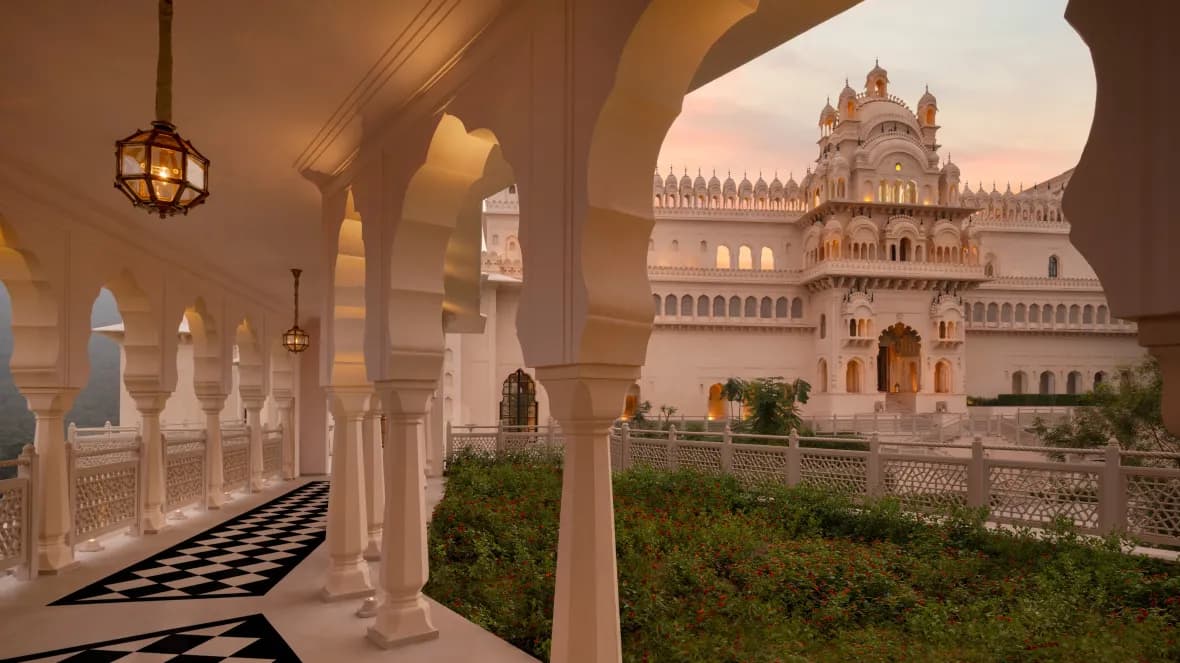
That the rulers of this Bundelkhand kingdom also created my next lodgings — a 350-year-old palace recently converted by Oberoi — makes perfect sense when I arrive later that day. Set within 76 acres of the forested Maniyagarh Hills, conveniently placed between Panna National Park and Khajuraho, Rajgarh Palace towers above a man-made lake like the fantasy creation in a Bollywood romance. When I arrive at twilight, hundreds of lanterns and windows glitter in little arches set into cream-coloured walls. Atop there is a crown of filigreed plasterwork. At the foot of the former fortified palace, a wide set of “elephant stairs” rises to the ornately painted Mastani entrance, at which the great beasts would deliver the maharajah as courtiers showered him with rose petals. When the Oberoi group was offered the lease on the palace in 1996, it was in a pretty sorry state: a haunt of vagrants and picnickers, and occasionally film crews (for the 1988 Merchant Ivory production The Deceivers, and Kamasutra: A Tale of Love directed by Mira Nair, the mother of Zohran Mamdani, New York’s new mayor).

Maanya, Rajgarh Palace’s fine-dining room
Oberoi Hotels & Resorts
But the legendary hotelier “Biki” Oberoi was enchanted by it, says his son, Vikram, the group’s chief executive, over drinks in the palace’s gloriously OTT carved and gilded Jaipur-style bar. Oberoi’s first job was to get water up to the palace by constructing a five-mile pipeline to a river. Then the team had to find ways to install electricity and plumbing within the old building, and to landscape the gloriously jungly grounds without disturbing its sal and palash forests.
Advertisement
Finally, after seven years of restoration, Rajgarh opened last November — sadly Biki, who died in 2023, never got to see its completion. Oberoi’s first heritage hotel, it has 17 grand, antique-filled suites over three floors and 48 elegant garden rooms scattered amid ancient ruins in the grounds.
India has scores of delightful heritage hotels but I’ve not seen one quite as regal. From the black-and-white marble flooring and chandeliers in the reception area, and the glittering silver thikri mosaics in the palace restaurant, to the suites adorned with Persian rugs and bespoke Chippendale-style furniture, this feels like a hotel designed for modern-day royalty. Staff swish about in cream silk saris and elegantly cut kurtas. Two giant swimming pools look out over a lake and Panna National Park (whose emerald reserves provided the park with its name, and the maharajah with a considerable fortune).
Read more luxury reviews, advice and insights from our experts
A spa will soon open by the water, with handmade boats to ferry guests for treatments. And the food, in three venues — a courtyard bar, a casual Italian-style lakeside brasserie and Maanya, a colonnaded speciality dining restaurant — includes pretty much anything a spoilt guest might want, from truffled pastas and English trifle to pork vindaloo, as well as a 12-course menu featuring royal delicacies of the princely states. When the ballroom is finished — with twinkling chandeliers, silk wall hangings and carved sandstone pillars —I can’t imagine any royal anywhere who wouldn’t want to host a party here.
Whether they will be as blessed by the tiger gods as I was, and see eight kings of the Indian jungle in two days (as well as gaur, langur, chital and sambar deer and wild boar) while being treated like a maharani is unlikely. As my Bandhavgarh naturalist said to me: “You, ma’am, are so lucky. That tiger sighting… it was the best of my life.”
Advertisement
Lisa Grainger was a guest of Greaves India. A nine-night tour staying in the Leela Palace Delhi, Taj Usha Kiran Palace, Oberoi Rajgarh Palace, Shatam Jeeva Retreat, Oberoi Vindhyavilas Wildlife Resort and the Oberoi Gurugram, costs from £4,455pp, with international British Airways flights, three game drives, private transfers and tours, based on two staying in a double room. A similar seven-day Oberoi itinerary, with private transfers throughout on a private Super King Air B200 plane and business-class BA international flights costs from £18,370pp, based on four travelling
Other palatial places to stay

Leela Palace’s cosy library bar
Leela Palace, New Delhi
In one of the most prestigious addresses to the south of the historic centre, this gilded bubble of indulgence is for those who desire old-fashioned sumptuousness rich with damask, embroidery, marble, mahogany and mirrors — and polished service. Highlights include a spacious two-floor contemporary spa; a surprisingly good, and stylish, Japanese restaurant (better than the Indian one); a private collection of Indian art; a cosy wood-panelled library bar; butler-style service and a hugely tempting pashmina shop.

The picturesque courtyard at Taj Usha Kiran Palace Hotel
Taj Usha Kiran Palace Hotel, Gwalior
This pretty former royal guesthouse, neighbouring the royal palace, is the closest a commoner can get to living like a minor Indian royal (if you can ignore the chaotic service), in a compact maze of 50 tastefully decorated historic rooms. Highlights include an intimate, homely atmosphere; a nine-acre garden lined with new tented rooms; a cosy garden spa where treatments are accompanied by a musician; a flamboyant welcome from a traditional band; a characterful courtyard for outdoor dining.
Details Doubles from £100 B&B, tajhotels.com

Oberoi Vindhyavilas Wildlife Resort offers tented suites, as well as western-style villas
AMIT MEHRA
Oberoi Vindhyavilas Wildlife Resort, Bandhavgarh National Park
Inspired by a contemporary African safari camp, with 19 canvas-roofed, glass-walled rooms set behind residential-looking hedged gardens, this is Bandhavgarh’s slickest new resort. Treats include game drives in comfortable, modified safari vehicles; Ayurvedic treatments using plant-based potions in a pretty lakeside spa, and a variety of tasty cuisine, from healthy salads to rich Indian dishes, delivered by attentive staff on a long veranda or by a firepit or pool. The best rooms are the tented suites, rather than the western-style villas.
Similar Articles
More from News