The Gentle Temptations Of Karaikudi, A Town Of Grand Chettinad Mansions
From grand Chettinad mansions and antique markets to handloom sarees and fiery local cuisine, Karaikudi offers a layered travel experience rooted in history, craft, and culture—best explored slowly and with curiosity
5 months ago
The road into Karaikudi is long enough for a song to settle into your bones.
In my case, it was an old Ilaiyaraaja number blasting through the taxi radio… “Aathadi Paavada Kathaada…”. It is a playful, mischievous song full of teasing romance.
Outside my window, the landscape rushed by in broad strokes. Village hamlets that appeared and vanished before I could fully take them in, agricultural patches, shepherds chasing after wayward sheep, and clusters of the avaram plant– its bright yellow flowers swaying under the sharp sun.
Somewhere between the song, the flowers, and the rhythmic hum of the wind from my open window, I realised, Karaikudi offers so many temptations…where do I even begin?
Should I head first to the antique markets, where Chettinad’s old homes surrender their doors, pillars, chandeliers, and trinkets to collectors? Or to the handloom mills where cotton becomes crisp Chettinad sarees? Or perhaps to the Athangudi tile workshops, small cottage industries where women mix sand, cement, and powdered pigments into neat moulds and produce tiles so luminous.
I was still debating with myself when my driver, Vinoth, joined the conversation.
He grew up in Pudukkottai, just a few miles from here, and therefore considers himself an authority on the region. His instructions were firm.
“Under no circumstances,” he said, “should you leave without visiting Pillayarpatti Vinayagar Kovil.”
I nodded solemnly. But the thing about solo travel is that you get to decide your own priorities. I exercised that privilege immediately, making my first stop the famous Thousand Window House.
“Andha jannalkal ellam clean panarthuku ettana naal akum,” wondered an old lady near me, peering at the grand façade. (How many days must it take to clean all those windows?)
“Aamaa… aanaa clean pannaala vittaalum onnume aavadh,” I teased.
(Yes… but even if you don’t clean it, nothing would happen)
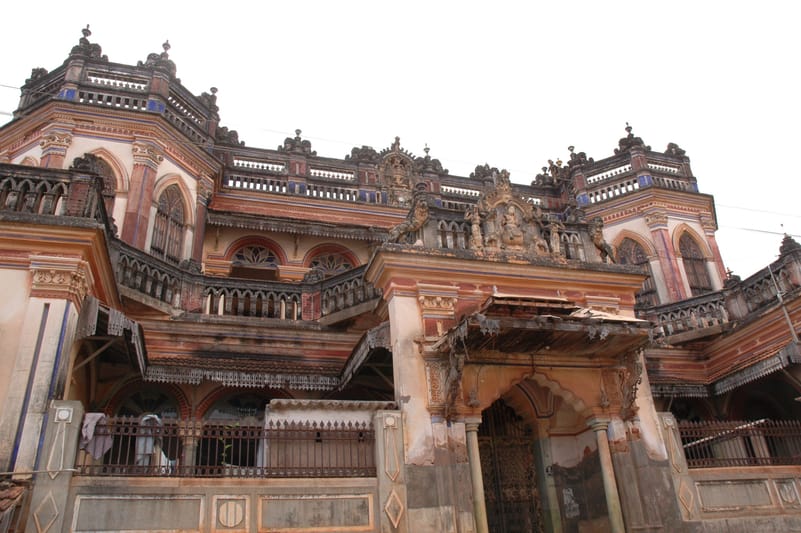
Architectural heritage of Karaikudi Photo: Shutterstock
Perhaps it was the Ilaiyaraaja song still lingering in the air, but everything felt faintly playful. The coyness of the lyrics had convinced me, momentarily, that life’s real purpose was simply to wander through landscapes, flirt with strangers, and invent small games to pass the afternoon.
Unfortunately, the house itself refused to cooperate with this philosophy. Much to my disappointment, the Thousand Window House was closed to visitors, so I stood outside its gates, took pictures from every angle, and attempted the impossible task of counting the windows. I gave up somewhere embarrassingly short of a fifty.
Just across the street, however, another compound had something far more accessible, a magnificent gooseberry tree. I ran across, but within minutes, my joyful gooseberry plucking was busted. Vinoth, suddenly the voice of reason, reminded me that we had an entire town to cover.
“If you want to tick everything on your list,” he announced, “you have to stop picking berries.” My restless soul agreed.
The Vintage Charm
And so we drove to Meenakshi Kovil Street, where Karaikudi’s antique shops sit shoulder to shoulder like treasure chests waiting to be opened. I stepped into Manikandan’s shop, and almost immediately my eyes fell on an ancient iron kettle.
“Only 1000 rupees,” he said.
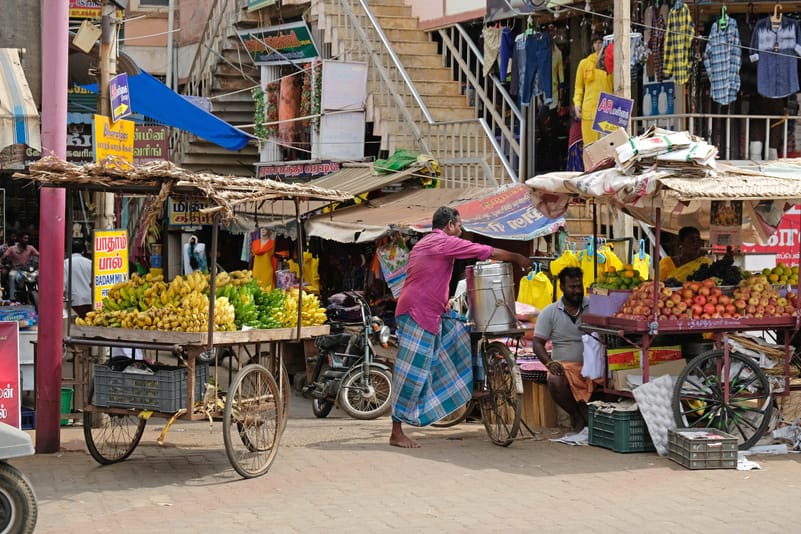
A market in Karaikudi Photo: Shutterstock
There was also a six-foot painting of an elderly Chettiar gentleman in a starched veshti with thin gold borders. Manikandan leaned forward and tapped the frame with authority.
“The veshti border has real gold thread.” For a brief moment, I was completely convinced that this elderly gentleman needed to come home with me. And then, I imagined my living room wall with this giant stern Chettiar patriarch gleaming at visitors through glass frames. Better sense prevailed, and I left the frame and the stare behind, and began doing what one must do inside a Karaikudi antique store: wander and wonder.
A goddess embossed in shimmering foil, a faded sepia family portrait, a painting of dancers frozen mid-movement in brown lacquered wood, a Japanese music box with a tiny key, a graceful figurine made of the most delicate china, a bright blue pot with a long handle and an elegant lid, and pendulum clocks, so many pendulum clocks of varying sizes!
It felt like rummaging through someone else’s attic, except the attic belonged to half the world.
Every item had come from a Chettinad house somewhere nearby. Houses that were once enormous, echoing with weddings, festivals, and funerals. Houses of accountants, cooks, and traders returning from Burma and Singapore. Houses with long corridors, teak pillars, Italian tiles, and Belgian mirrors.
Now many of those homes stood half-empty, and here I was, trying to be a part of their story, with objects they once held dear.
I must have walked up and down the store four or five times, pretending to inspect every old thing, while actually just enjoying the feeling of being surrounded by so much history.
Manikandan watched all this with the patience of a shopkeeper who knew exactly what would happen next. Sooner or later, every visitor leaves with something.
In my case, it was the iron kettle and a few brass thingamajiggies.
Architecture Frozen In Time
My next stop was Sri Letchmi Vilas, one of the grand Chettinad mansions that now stands somewhere between a residence, a museum, and a time capsule. From the outside, the building is theatrical in the way only Chettinad houses can be. The facade rises in tiers of pale cream and muted pastels, crowded with statues… horse riders, guardians, flowers, and deities. Frozen in mid-gesture as if they had been watching visitors arrive for a hundred years. The entrance arch holds a small shrine-like alcove, and above it, a cascade of carved figures, each patiently holding up the house’s elaborate crown. Even before stepping inside, you get the sense that this is not simply a home but a declaration of prosperity, built by a community that once traded across the world.
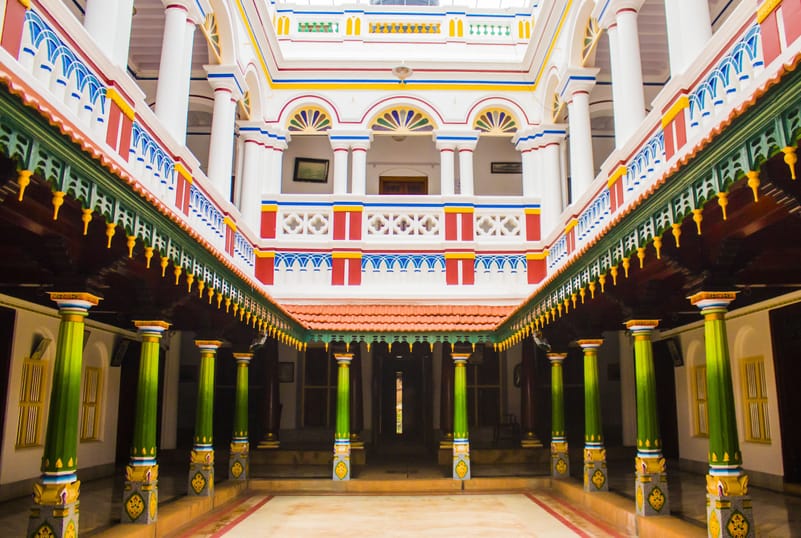
Inside a Chettinad mansion (representational) Photo: Shutterstock
Inside, the drama becomes more impressive. Long corridors stretch into soft light, lined with polished black columns and floors laid out in crisp geometric tiles that feel cool underfoot. The ceilings are a riot of colour and intricate floral panels painted in repeating patterns that seem to bloom endlessly overhead. In the central courtyard, delicate iron railings frame balconies above, where pastel pillars and ornate arches create a layered symmetry that feels both Indian and faintly European. Light filters in through coloured glass windows, scattering green and blue across the wooden doors and tiled walls. Walking through the house felt less like touring a building and more like moving through an elaborate memory of Chettinad’s mercantile past, where wealth, artistry, and a sense of permanence once lived comfortably under the same roof.
It’s nearing 2 PM, and I ask Vinoth for the nearest place where one can find proper Chettinad food. “Aachi,” he says. “Two kilometres.”
The Chettinad Plate
The restaurant/mess appears almost modestly beside the road, a place you might miss if you were not looking for it. There’s a standee outside the building, no signage, and it’s run by a mother and her sons. Inside, plantain leaves are spread out, a pattern I’ve seen across restaurants in this region. It’s always a plantain leaf, never a plate, no matter what the meal.
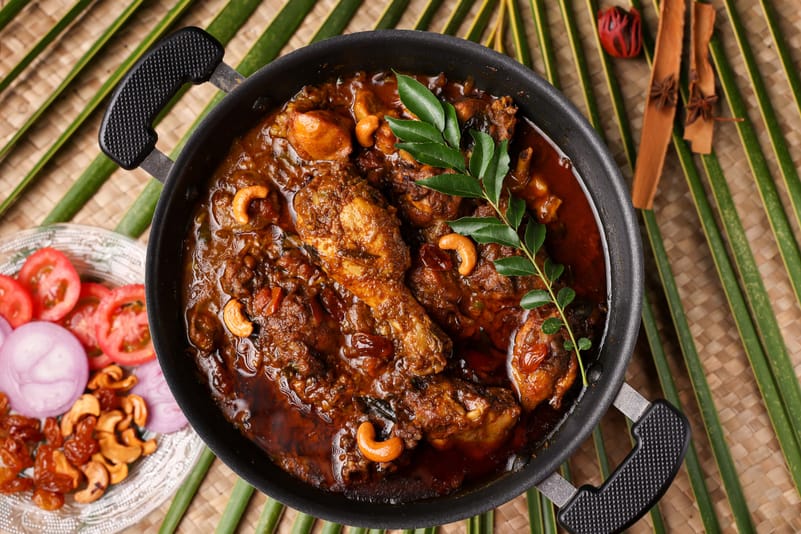
Chettinad chicken curry is a flavourful, spicy dish from the Chettinad region of Tamil Nadu Photo: Santhosh Varghese/Shutterstock
There is Chettinad chicken, fiery and fragrant, a crisp fish fry that crackles slightly as it hits the leaf, steaming rice with rasam, beetroot and potato poriyal, and cabbage poriyal cooked just enough to keep its sweetness. Every bite feels grounding, and exactly what the body needs after a morning of wandering through old houses and antique shops. To finish, they bring a small tumbler of dal payasam. It is deeply comforting and cooling in the way only a simple chilled payasam can be on a scorching afternoon.
Sufficiently restored, I climb back into the car, and yes, the afternoon already feels far more manageable. Our next stop lies just a short drive away, a handloom weaving centre where Chettinad cotton sarees are still made the old way.
The Weave
Inside the shed, there is the rhythm of the loom. Wooden frames stretch across the room, threads pulled taut in neat mathematical lines. A weaver sits diligently at one end, hands moving with practised precision as he guides the shuttle back and forth through hundreds of stretched threads. The warp threads glow in shades of mustard yellow and deep green, colours that feel almost inevitable in this landscape of sun and earth.
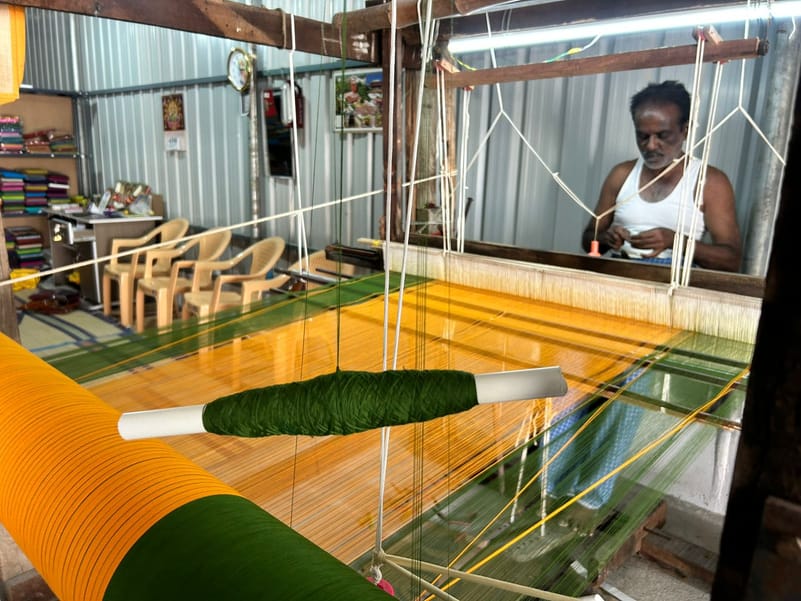
Weaver at work Photo: Anju Narayanan
Watching a loom at work is strangely hypnotic. The motion is repetitive yet delicate, every pull of the thread slowly building the geometry of a saree. Nearby shelves hold neatly folded stacks of Chettinad cottons, with bold checks, vibrant stripes, colours stacked like blocks of festival powder.
I linger for a while, watching the loom and the weaver’s deft hands managing it with muscle memory. Then I begin rummaging through the stacks of sarees, pulling out colours I would normally walk past. If one is in Chettinad, one must not be tempted to go for brick red. Or mustard. I hold up a few against the light, fold them back carefully, and finally pick a couple that feel just unfamiliar enough to be exciting.
Before leaving, I refill my water bottle and say goodbye to the weavers, clutching their visiting card like a small promise.
“I’ll call from Bangalore,” I say. They nod the way people do when they have heard this many times before.
Inside The Pillayarpatti Temple
It is nearly 4 PM now, and the day is beginning to lean toward evening. I am staying in a nearby town and have a train to catch later. In theory, the sensible thing would be to start heading back. But of course, there is the temple stop.
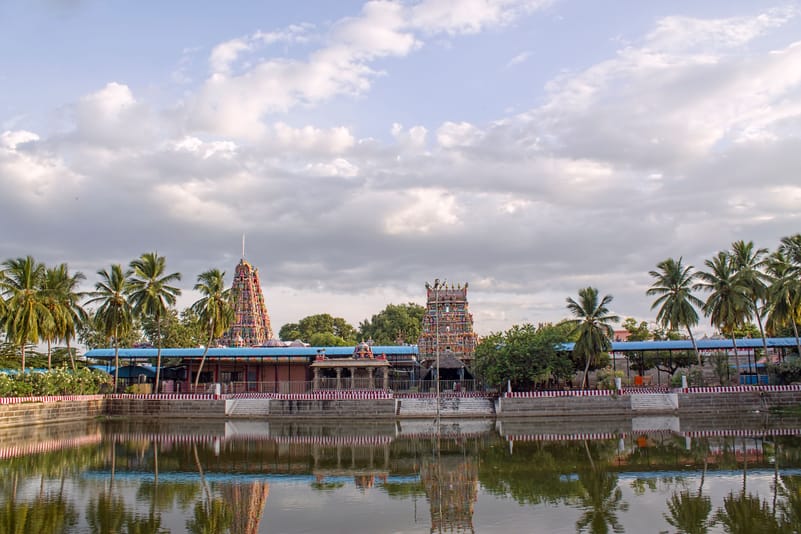
Pillayarpatti Temple Photo: Shutterstock
The Pillayarpatti Vinayagar Temple re-opens its doors for the day at 4 PM, and a steady queue is already forming. This rock-cut cave shrine is home to a rare, two-handed Ganesha idol with a trunk curled to the right. It's one of Tamil Nadu's oldest cave temples, with inscriptions suggesting construction possibly in the 4th-7th centuries CE by the Pandyan kings. In fact, the inner sanctum is a cave, preventing traditional pradakshina (circumambulation) around the deity. Photography is strictly forbidden, and perhaps that is just as well. Some places insist on being remembered rather than recorded. The crowd is dense but purposeful. Devotees move forward in a steady rhythm, a tide of bodies flowing toward the sanctum and out again. I fall into that rhythm without trying, carried gently forward by the queue. Within half an hour, it is over.
My visit to Karaikudi has been brief, barely a day, but it feels fuller than many longer journeys. On the way back, we stop at a small bakery to try the local favourite, Paal Bun. These small, round dough balls are deep-fried and dipped in sugar syrup. One bite in, and your hand automatically reaches for the next. A hot cup of black coffee later, as we drive away, I realise I already know one thing for certain. I’ll be back.
Karaikudi, after all, is not the sort of place that lets you leave with just one story.
The Information
How To Reach Karaikudi
The nearest airport to Karaikudi is Tiruchirapalli (TRZ), about 77.5 km away. Madurai Airport (IXM) is another convenient option, located roughly 78.5 km from the town. Karaikudi is also well connected by rail through Karaikkudi Junction (KKDI), the principal railhead serving the Chettinad region and Sivaganga district, with trains linking it to several major cities.
If you are travelling from Madurai or Trichy, the quickest way to reach Karaikudi is by taxi or private car, which takes about 1 hour 20 minutes to 1 hour 50 minutes for a distance of roughly 85–90 km. Buses run frequently but can take longer depending on stops and traffic, while train journeys often involve transfers and are typically less convenient for this route.
FAQs
1. What is Karaikudi famous for?
Karaikudi is known for its grand Chettinad mansions, antique markets, traditional cuisine, Athangudi tiles, and rich cultural heritage.
2. What are the must-visit places in Karaikudi?
Key attractions include Aayiram Jannal Veedu (Thousand Window House), Chettinad mansions like Sri Letchmi Vilas, antique markets, handloom centres, and the Pillayarpatti Vinayagar Temple.
3. What makes Chettinad architecture unique?
Chettinad architecture blends Indian and European influences, featuring large courtyards, ornate facades, teak pillars, Italian tiles, and intricate detailing.
4. What food should you try in Karaikudi?
Chettinad cuisine is a highlight, with dishes like Chettinad chicken, fish fry, rasam, poriyal, and traditional desserts like payasam.
5. How can you reach Karaikudi?
Karaikudi is accessible via Tiruchirapalli and Madurai airports, and by rail through Karaikkudi Junction. Road travel from nearby cities is the most convenient option.
Similar Articles
More from News